
Laser Tattoo Removal in Dwarka: What Is Realistic for Your Tattoo
Laser tattoo removal in Dwarka — honest costs from ₹2,500 a session, how many sittings each ink colour needs, and what full removal really looks like.
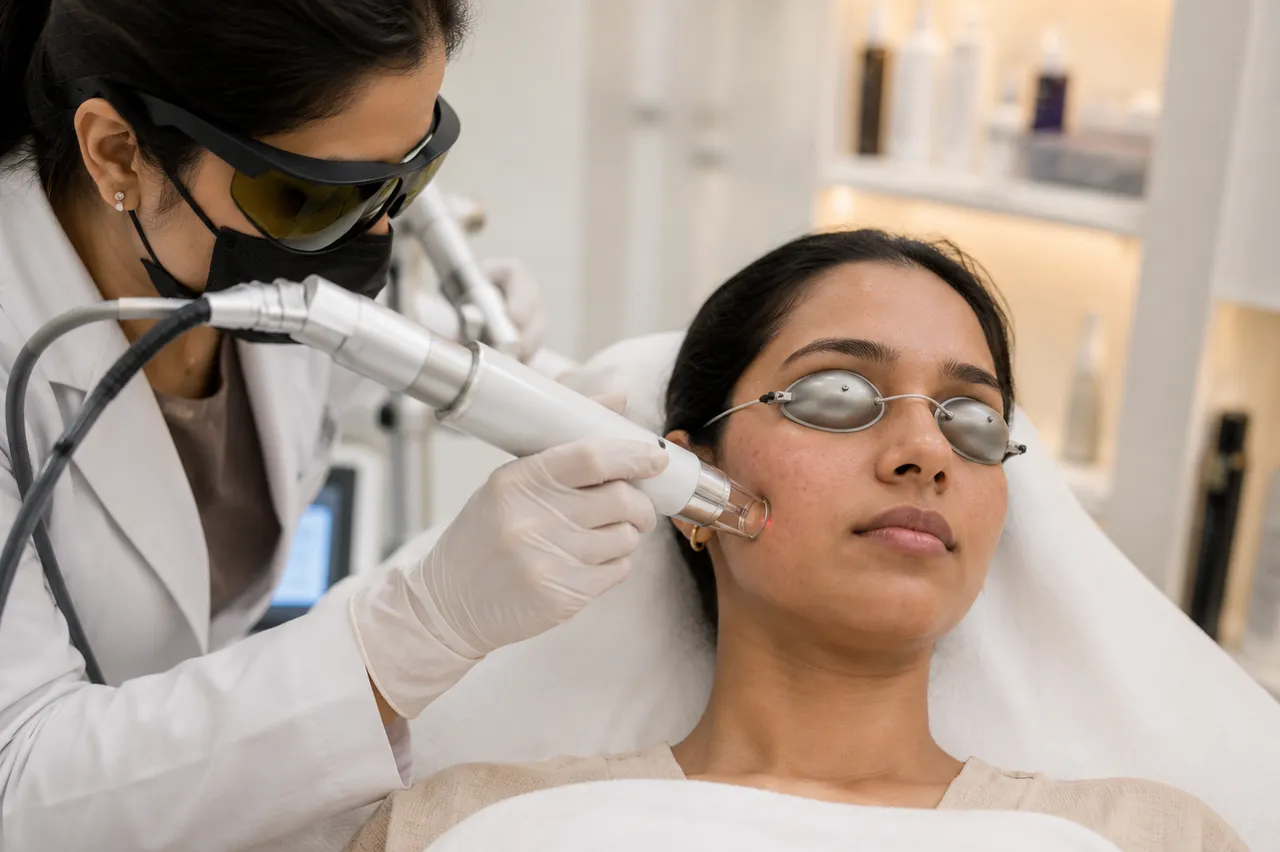
A coin-size black tattoo starts from ₹2,500 a session at our Dwarka clinic — and it will realistically take six to ten of those sessions, spaced six to eight weeks apart. That’s the full answer, and it’s the part most people don’t hear before they book.
Here’s the mechanism, because it explains everything else. A Q-Switch laser fires pulses measured in billionths of a second. The ink absorbs that energy and shatters into fragments too small to stay lodged in the skin. Your own immune system then carries those fragments away over the following weeks. The laser doesn’t erase a tattoo. It breaks the ink into pieces small enough for your body to clear — which is why the gap between sessions matters as much as the sessions themselves.
Why nothing much happens after session one
This is the conversation we have most often. Someone comes in a week after their first sitting, holds up their forearm, and says it looks identical.
It usually does. The fading happens in the six to eight weeks between sittings, as the fragmented ink is gradually flushed out. Session one loosens the top layer of ink; the visible change often shows up around sitting three or four. People who quit at session two rarely quit because the treatment failed — they quit because nobody set the timeline for them.

Q-Switch pulses shatter the ink; the fading happens over the following weeks as your body clears the fragments.
Ink colour decides almost everything
Two tattoos of identical size can need wildly different courses, purely because of colour.
Black and dark blue absorb across the widest range of wavelengths, so they break down most readily. A plain black script tattoo is the straightforward case.
Red generally responds well too, though it can behave unpredictably in some people.
Green and sky blue are the stubborn ones. They reflect the wavelengths that clear black, so they need a specific wavelength and more patience — expect extra sittings and accept that a stubborn teal may only fade rather than vanish.
Yellow, orange and white are the hardest of all. White ink in particular can darken instead of lighten, because some white pigments react to laser energy. If your tattoo has white highlights, that needs a proper look and a patch test first, not an optimistic booking.
Amateur tattoos clear faster than professional ones
Counter-intuitive, but consistent. A stick-and-poke or a friend’s-garage tattoo is usually shallow, patchy and light on pigment — often four to six sessions. A professional piece is machine-packed, deep and dense, with layered shading — often eight to twelve, sometimes more.
Cover-ups are the hardest cases. A cover-up is two tattoos stacked on top of each other, so there’s roughly double the ink to break down. Same for anything heavily blacked-out.
Location matters too. Ink on the chest, back and upper arms clears faster than ink on the ankles, feet and fingers, where circulation and lymphatic drainage are slower.
What it actually costs in Dwarka
| Tattoo | Per session | Realistic sessions | Time on the calendar |
|---|---|---|---|
| Coin-size, amateur, black | from ₹2,500 | 4–6 | 6–9 months |
| Coin-size, professional, black | from ₹2,500 | 6–10 | 9–15 months |
| Palm-size, single colour | Quoted at consultation | 8–12 | 12–18 months |
| Multi-colour or cover-up | Quoted after seeing it | 10–15+ | 18 months or more |
The number that surprises people isn’t the rupee figure. It’s the calendar. Tattoo removal is a slow, staged commitment, and anyone who quotes you a flat one-time price for “complete removal” before seeing the tattoo is guessing. Our full rate card is on the pricing page; larger pieces are quoted at consultation, once ink density and colours have been assessed.
The six-to-eight week gap isn’t padding
Two reasons for it. Your immune system needs those weeks to actually clear the shattered pigment — go back too soon and you’re firing at ink that hasn’t moved yet. And the skin barrier needs time to recover, especially in Delhi’s heat and dust.
Squeezing sittings closer together doesn’t speed up the result. It raises the risk of blistering and lasting pigment change. We space them out, and we push back when someone asks to compress a course before a wedding.

Every course starts with an assessment of ink density, colour and skin type — never a phone quote.
The session, and the week after
The pulse feels sharper than hair-removal laser — closer to hot oil flicked on skin than a rubber-band snap. It’s brief. A coin-size tattoo is over in a couple of minutes, and numbing cream is available for tender spots.
Immediately after, the area turns white and raised for fifteen to twenty minutes. That’s called frosting, it’s expected, and it settles. Then you get redness and swelling for a day or two, sometimes pinpoint bleeding, occasionally a blister. Scabbing typically appears around days three to seven.
Aftercare is simple and non-negotiable:
- Keep it clean, dry and covered for the first few days, with the ointment we give you.
- Don’t pick the scab. Picking is the single most common cause of a mark that stays.
- Skip the gym, swimming and steam for about 48 hours — sweat on a fresh site invites trouble.
- Sunscreen on the area daily once healed, and keep it out of direct Delhi sun for the whole course.
Sessions run under clinical protocols with trained professionals on internationally certified devices, and every course starts with a patch test.
Honest limits — the part nobody puts on a poster
Complete removal isn’t guaranteed for every tattoo. For dense multi-colour work, the realistic goal is heavy fading — invisible at conversational distance, or light enough to take a clean cover-up. That’s a genuinely good outcome, and we’d rather set that expectation upfront.
Ghosting happens. A faint shadow of the design can remain even after the course is complete.
Pigment changes are real on Indian skin. Temporary darkening around the treated area is common and usually settles over a few months. Lightening is less common but can persist. Sun exposure during the course makes both more likely.
Tattoo removal is not appropriate right now if the tattoo is less than six to eight weeks old and still healing, if the skin over it is tanned, infected or broken, during pregnancy or breastfeeding, or within about six months of certain oral acne medication. Keloid-prone skin needs a careful, cautious assessment.
One myth worth killing: the hair-removal laser cannot remove tattoos. Different target, different mechanism. So can removal creams and “needle removal” — those mostly deliver irritation and scars. The clinical route is Q-Switch laser, and there isn’t a shortcut around it.
Key takeaway: Laser tattoo removal is priced per session, from ₹2,500 for a coin-size piece, and most tattoos need 6–12 sittings spaced 6–8 weeks apart. Black ink clears fastest, green and yellow the slowest, and cover-ups take the longest. Judge progress at session four, not session one.
Get your tattoo assessed in Dwarka
Send us a clear photo before you commit to anything. We’ll tell you honestly what colours you’re dealing with, roughly how many sittings it’s likely to need, and whether full clearance or heavy fading is the realistic goal for your ink.
Brightonic is in Sector 8, Dwarka, near the Sector 9 Metro — an easy trip from Sector 12, Palam and Janakpuri. WhatsApp +91 74007 60054 with a photo, or book a consultation for a patch test. Open 7 days, 10 AM–8 PM.
Quick answers
- How much does laser tattoo removal cost in Delhi?
- At Brightonic in Dwarka, Q-Switch tattoo removal starts from ₹2,500 a session for a coin-size design, with larger pieces quoted once the tattoo has been seen. The price is per session, not per tattoo, so budget for the whole course — most tattoos need several sittings spaced six to eight weeks apart.
- How many sessions does laser tattoo removal take?
- Most professional tattoos need eight to twelve sessions, while amateur or stick-and-poke work often clears in four to six because the ink sits shallower and thinner. Black and dark blue respond quickest. Green, sky blue and yellow take considerably longer and sometimes never fade completely, whatever the device used.
- Does laser tattoo removal leave a scar?
- Usually not. Q-Switch pulses target the ink rather than cutting skin, so most people heal with normal-looking skin. Visible scarring is more often left over from the original tattooing itself. Temporary darkening, lightening or a faint ink shadow can remain, especially on Indian skin, which is why aftercare and sun protection matter.
This article is general information from the Brightonic team and is not a substitute for personal medical advice. Suitability and outcomes are assessed individually at consultation.
Considering a treatment?
Book a calm, no-pressure consultation at our Sector 8, Dwarka centre.
Related treatment: Laser hair reduction in Dwarka