
Treatment
Pigmentation & Q-Switch Laser Treatment in Dwarka
Dark spots, post-acne marks, tanning and stubborn patches — diagnosed first, then treated with the option that actually suits that type of pigment.
Clinically reviewed ·
From ₹2,500 / session view price list
- Session
- 20–40 minutes
- Downtime
- Minimal — mild redness for a few hours
- Course
- Usually 4–6 sessions, 3–4 weeks apart
- Treats
- Dark spots, post-acne marks, tanning, tattoos
Pigmentation is four different problems wearing the same name
“Pigmentation” is what people say at the front desk. Underneath it are at least four conditions, and they do not share a treatment. Getting the type right is most of the result — which is why nothing is switched on at Brightonic until we have worked out which one you have.
| What you see | What it usually is | How it behaves |
|---|---|---|
| Symmetrical brown patches on cheeks, forehead, upper lip | Melasma | Chronic. Flares with sun and hormones. Managed, not cured |
| Flat brown marks where pimples used to be | Post-inflammatory hyperpigmentation (PIH) | Fades over months; faster with treatment |
| Face and arms darker than covered skin | Tanning | Surface pigment. The most reversible |
| Small, well-defined dark spots, usually sun-exposed areas | Sun spots (lentigines) | Stable. Responds very well to laser |
What a Q-Switch laser actually does
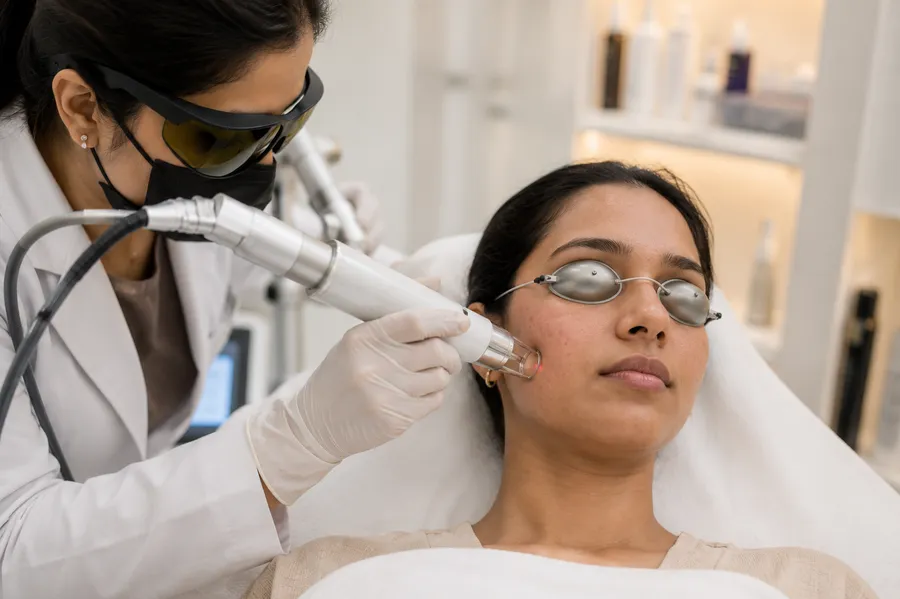
A Q-Switch laser fires energy in extremely short pulses — billionths of a second. That speed matters: the pulse shatters pigment particles before heat has time to spread into surrounding skin. The body then clears the fragments gradually over the following weeks.
For Indian skin we use the 1064 nm wavelength. It travels deeper with less absorption at the surface, which is what keeps the risk of burns and rebound darkening low on darker skin tones.
It treats pigment. It does not tighten skin, shrink pores permanently, or treat active acne — those are different problems with different treatments.
What it works well for
Sun spots and discrete dark spots. The clearest results. Well-defined pigment is exactly what the laser targets.
Post-acne marks. Once breakouts are controlled, marks that have not faded on their own respond well. PIH is more common and lasts longer in darker skin tones (DermNet), which is why it is such a frequent concern in Delhi.
Tanning. As a carbon laser peel, the same device lifts surface tan and buildup in one session with no downtime.
Tattoo lightening and removal. Multiple sessions; black ink responds best.
Long-standing dark underarms, knees, elbows — as part of a plan, after the cause has been addressed.
Melasma: the honest version
This is where a lot of clinics oversell, so it is worth being direct.
Melasma is more common in women, typically starts between the ages of 20 and 40, and is most prevalent in medium-to-darker skin types — which describes most of our clients. Around 60% of people with melasma report an affected family member (DermNet).
It is chronic. Even after successful treatment, pigment can reappear with summer sun. Dermatology references are explicit that lasers “carry a high risk for relapse” in melasma and can make it more resistant to treatment.
So our order of treatment for melasma is:
- Sun protection, every day, all year. Broad-spectrum SPF 50+, reapplied. Without this nothing else holds.
- Topical treatment to settle the overactive pigment cells.
- Clinical peels at a depth chosen for your skin type.
- Low-energy laser toning — cautiously, and only if it is indicated.
If someone offers to laser your melasma away in three sittings, that is a sales pitch. The American Academy of Dermatology describes the same picture: melasma can be stubborn and often needs ongoing maintenance.
What to expect from a course
- Session: 20–40 minutes. Eye shields on. The sensation is a quick warm snap, like a fine rubber band.
- Straight after: mild redness and warmth for a few hours. Treated spots often look slightly darker for several days before they lighten — that is the pigment breaking up, not a bad reaction.
- Spacing: 3–4 weeks between sessions, so skin can clear the fragments.
- Course: usually 4–6 sessions. Visible change typically begins after the second or third.
- Afterwards: sunscreen is not optional. Treated skin re-pigments quickly under Delhi sun.
Who should wait
Laser is postponed if you have an active infection or cold sore in the area, a recent deep tan or sunburn, are pregnant, or are on medication that makes skin light-sensitive. Tell us about isotretinoin-type acne treatment in the last six months. A patch test is done before a first course.
Pricing
- Q-Switch de-pigmentation — ₹4,000 a session
- Carbon laser peel — ₹4,000 a session
- Q-Switch tattoo removal — from ₹2,500 (coin-sized area)
A word on very cheap laser packages: under-powered settings are comfortable and do little; over-powered settings on Indian skin cause the rebound darkening people then spend a year correcting. Ask what wavelength is used and who is operating it.
Related reading
- Pigmentation on Indian skin — what works
- Dark underarms — causes and treatment
- Those dark marks after pimples — why they linger
At the clinic
Assessed and performed by trained professionals under clinical protocols at our Sector 8, Dwarka centre — a short walk from Sector 9 Metro, easy from Sector 12, Palam, Janakpuri and Uttam Nagar. Open 7 days, 10 AM–8 PM.
Book a pigmentation assessment — you will be told which type you have before you are told what to buy.
Outcomes vary between individuals. Suitability and the number of sessions are confirmed at consultation.
Pigmentation & Q-Switch Laser Treatment in Dwarka — your questions
What is the best treatment for pigmentation in Dwarka?
It depends on which type of pigmentation you have, which is why diagnosis comes first. Sun spots, post-acne marks and tanning respond well to Q-Switch laser and clinical peels. Melasma is different — it is managed mainly with strict sun protection and prescription-strength topicals, with laser used cautiously because it can relapse. Brightonic in Sector 8, Dwarka assesses the type before recommending anything.
Does Q-Switch laser remove melasma permanently?
No treatment removes melasma permanently, and any clinic that says otherwise is overselling. Melasma is a chronic condition driven by sun, hormones and genetics, and it tends to return with sun exposure. Dermatology references note that lasers carry a real risk of relapse in melasma, so they are a cautious add-on, not the first step.
How many Q-Switch laser sessions are needed for dark spots?
Most people need around four to six sessions spaced three to four weeks apart, with visible lightening usually beginning after the second or third. Discrete sun spots and post-acne marks respond fastest. Deeper or older pigment takes longer, and results vary between individuals.
How much does pigmentation treatment cost in Dwarka?
At Brightonic in Sector 8, Dwarka, Q-Switch de-pigmentation is ₹4,000 a session, the carbon laser peel is ₹4,000, and Q-Switch tattoo removal starts from ₹2,500 for a coin-sized area. The number of sessions is confirmed after your skin is assessed.
Is Q-Switch laser safe for Indian skin?
Yes, when the wavelength and energy are chosen for darker skin tones. The 1064 nm setting used for Indian skin passes deeper with less surface absorption, which lowers the risk of burns and rebound darkening. A patch test, conservative energy and strict sun protection afterwards are what make it safe.
Can Q-Switch laser help with dark underarms?
It can help when darkening is long-standing and set in, usually alongside brightening peels. But the main cause of dark underarms is repeated shaving or waxing, so stopping that trauma comes first. Velvety, thickened darkening is checked for insulin resistance before any cosmetic treatment is offered.
Serving Dwarka, Sector 8 Dwarka, Raj Nagar Extension, Sector 7 Dwarka, Sector 6 Dwarka, Sector 12 Dwarka and nearby areas of South-West Delhi.