
PCOS Facial Hair: Why It Happens and What Laser Can (and Can't) Do
Honest guidance from a Dwarka clinic on PCOS facial hair — why androgens drive chin and upper-lip growth, and what laser realistically can and can't do.
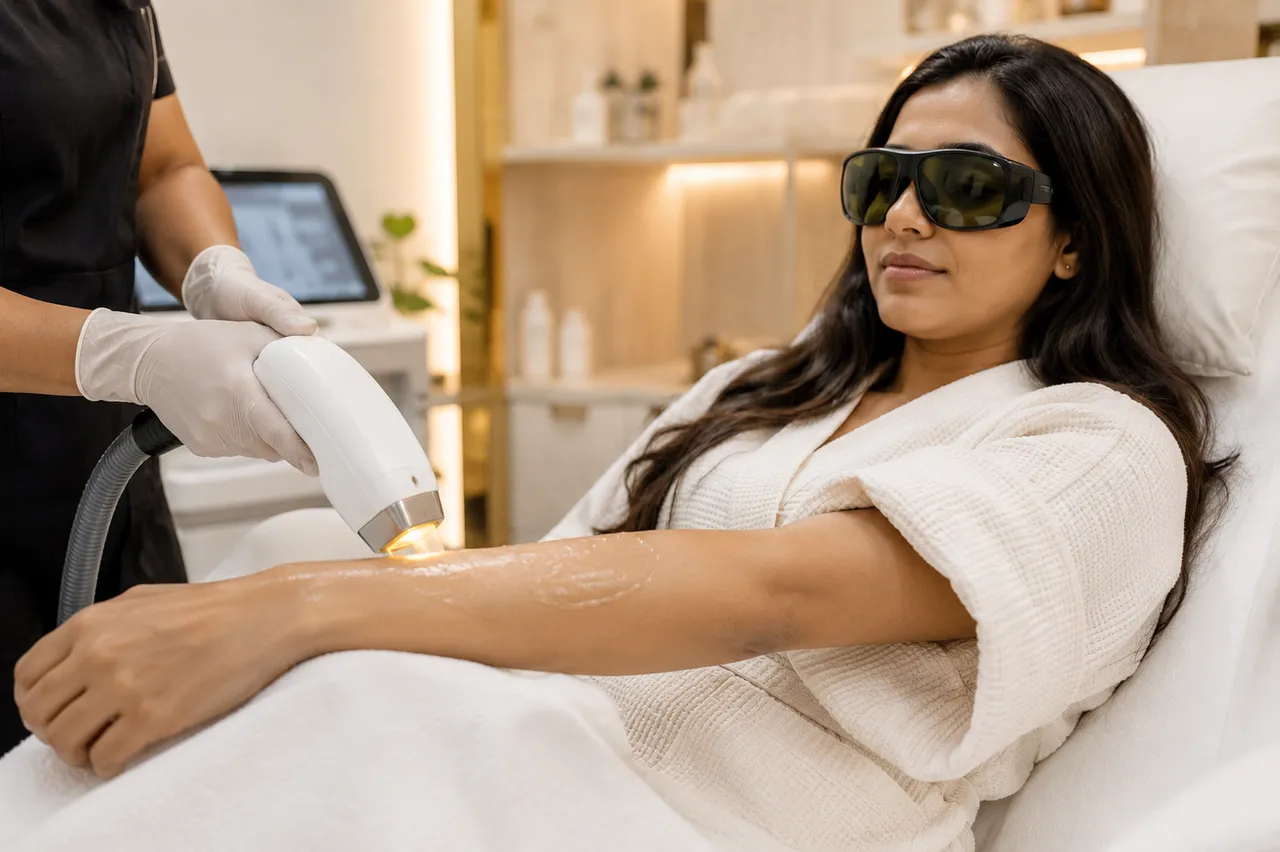
If you’re here because coarse hair on your chin, jaw or upper lip keeps coming back no matter how often you thread it — first, you haven’t done anything wrong. This is hormonal, it’s common, and there’s a real plan for it. The short answer: laser works very well on PCOS facial hair, but it manages it rather than cures it. Expect a big, lasting reduction plus occasional maintenance, because the hormones behind the hair don’t switch off.
Here’s the honest, full picture.
Why PCOS puts hair on your chin and lip
PCOS (polycystic ovary syndrome) nudges up your levels of androgens — hormones everyone has, but which are higher in PCOS. Androgens are the signal that tells a hair follicle to stop making soft, invisible fuzz and start making thick, dark, rooted hair instead.
The chin, jawline and upper lip are simply the areas most sensitive to that signal. So the same follicles that sat quiet for years suddenly grow coarse hair — often fast, often stubborn.
Two things matter here. One: it’s a hormone doing this, not hygiene, not shaving, not anything you caused. Two: because it’s a hormone, it keeps sending the signal. That single fact explains everything about how laser behaves on PCOS hair.

We map exactly which areas are affected before quoting a plan — chin, upper lip and jaw each behave a little differently.
What laser can do — and what it can’t
Let’s be precise, because vague promises help no one.
What laser genuinely does: it targets the pigment in each rooted hair and disables that follicle. Coarse, dark PCOS hair is actually an ideal target — there’s plenty of pigment for the laser to lock onto. After a full course, most people see a 70–90% reduction in the hair that’s currently active, and what regrows comes back finer and slower.
What laser can’t do: stop your hormones from waking up brand-new follicles later. Laser only disables the follicles that exist and are growing now. PCOS keeps recruiting fresh ones over the months and years ahead. That’s not a failure of the laser — it’s the difference between treating hair and treating a hormone.
So the realistic frame isn’t “six sessions and it’s gone forever.” It’s excellent control with light ongoing maintenance — smooth most of the time, with a top-up when the hormones activate a new batch. For most women, that’s the difference between a daily mirror battle and a quick session a few times a year.
Why laser beats threading, waxing and plucking here
This is the part we wish more women knew earlier. Repeatedly pulling coarse hormonal hair — threading, waxing, tweezing, epilating — has real downsides on PCOS-prone skin:
- Ingrown hairs. Coarse hair that’s ripped out often curls back into the skin as it regrows, leaving painful bumps along the jaw and chin.
- Pigmentation. Repeated trauma to the same patch of facial skin can darken it over time — a shadow that lingers long after the hair.
- It never actually slows down. Pulling a hair doesn’t reduce the follicle count; it grows back on schedule, sometimes coarser.
Laser does the opposite: it reduces how many follicles stay active, so there’s simply less hair over time, and it skips the yank-and-regrow cycle that irritates skin.
| Laser | Threading / waxing | Plucking | |
|---|---|---|---|
| Effect over time | Fewer active follicles, thinner regrowth | No reduction, regrows on schedule | No reduction, can coarsen |
| Ingrown risk | Low | Moderate–high | High |
| Pigmentation risk | Low with correct settings | Builds with repeated trauma | Builds with repeated trauma |
| Upkeep for PCOS | Top-ups a few times a year | Every 1–2 weeks, indefinitely | Daily/weekly, indefinitely |
A realistic plan and what it costs
For PCOS facial hair, the pattern we see at the clinic looks like this:
- 6–8 core sessions, spaced roughly 4–6 weeks apart, to work through the growth cycles and knock down the active follicles.
- Periodic top-ups after that — often once every few months, tapering as things settle — to catch newly hormone-activated hairs before they get established.
Facial areas are small, so they’re priced accordingly: laser for areas like the upper lip or chin starts from ₹1,500 per session. Many clients combine chin, lip and jaw into one short appointment. You’ll get an honest session estimate for your hair at a consultation — coarse dense growth and fine sparse growth respond differently, and we’d rather quote you accurately than optimistically.

Facial sessions are quick — the coarse, dark hair PCOS produces is exactly what laser targets most efficiently.
Treat the hormones too — this is important
We’ll say this plainly because it’s the most useful thing in this article: we handle the hair, not the hormones. Laser is a fantastic tool for managing the symptom, but PCOS is a whole-body hormonal and metabolic condition, and it deserves proper medical care of its own.
Please see a gynaecologist or endocrinologist about the PCOS itself — cycle regulation, insulin and weight factors, and the underlying hormonal picture. When the hormones are better managed, fewer new follicles get activated, which means your laser results hold longer and your top-ups get further apart. The two work together. Laser without hormonal care still helps a lot; laser with it helps more, for longer.
That’s us staying in our lane — and pointing you toward the care that makes our part work better.
Who should patch test first
Everyone gets a patch test before their first facial session, and it matters more here, because facial skin is delicate and PCOS often travels with sensitive or pigment-prone skin. A patch test is essential if you:
- have deeper or easily-pigmenting skin tones,
- are on any medication that affects skin sensitivity (mention everything at consultation),
- have had irritation, darkening or breakouts from previous hair removal,
- or are pregnant or think you might be — in which case we’d wait.
The test is quick, and it’s how we set the right energy for your skin rather than a one-size setting.
Key takeaway: Laser is the most reliable long-term option we have for PCOS facial hair — a 70–90% reduction after 6–8 sessions, far gentler on the skin than repeated threading or waxing — but it’s ongoing management, not a permanent cure. Pair it with medical care for the PCOS itself, and the results last longer with fewer top-ups.
Getting it done properly in Dwarka
Brightonic is in Sector 8, Dwarka — with laser platforms suited to Indian skin tones, a patch test before your first session, and honest session estimates given by trained professionals under clinical protocols. We treat PCOS facial hair every week, so you won’t have to explain the embarrassment of it — we already understand. We’re an easy visit from Sector 12, Palam, Janakpuri, Uttam Nagar and Najafgarh, open 7 days, 10 AM–8 PM.
WhatsApp +91 74007 60054 to tell us which areas are bothering you, and we’ll give you a realistic plan for your hair and skin.
See laser details & pricing · Explore our skin treatments · Book a consultation
Quick answers
- Can laser remove PCOS facial hair permanently?
- Laser gives excellent long-term control of PCOS chin and upper-lip hair, but not a one-and-done cure. Because PCOS hormones keep activating new follicles, you get a large reduction after 6–8 sessions, then occasional top-ups to stay smooth. Think ongoing management rather than a single permanent fix.
- Why does PCOS cause chin and upper-lip hair?
- PCOS raises androgen (male-type hormone) levels, and androgens turn fine, barely-visible facial hair into coarse, dark, rooted hair — usually on the chin, jaw and upper lip. It's a hormonal signal, not poor hygiene or anything you did wrong, which is why it helps to treat the hair and the hormones together.
- Is laser better than threading or waxing for PCOS hair?
- For most women with PCOS, yes. Threading, waxing and plucking pull hair repeatedly, which for coarse hormonal hair often means ingrown hairs and darkening of the skin over time. Laser reduces how many follicles stay active instead of yanking them, so regrowth thins out and the skin stays calmer.
This article is general information from the Brightonic team and is not a substitute for personal medical advice. Suitability and outcomes are assessed individually at consultation.
Considering a treatment?
Book a calm, no-pressure consultation at our Sector 8, Dwarka centre.
Book a Consultation →