
Acne Scars in Dwarka: What Actually Fades Them (and What Won't)
Acne scars treatment in Dwarka — how to tell marks from true scars, what actually fades each, and honest timelines from a Sector 8 clinic.
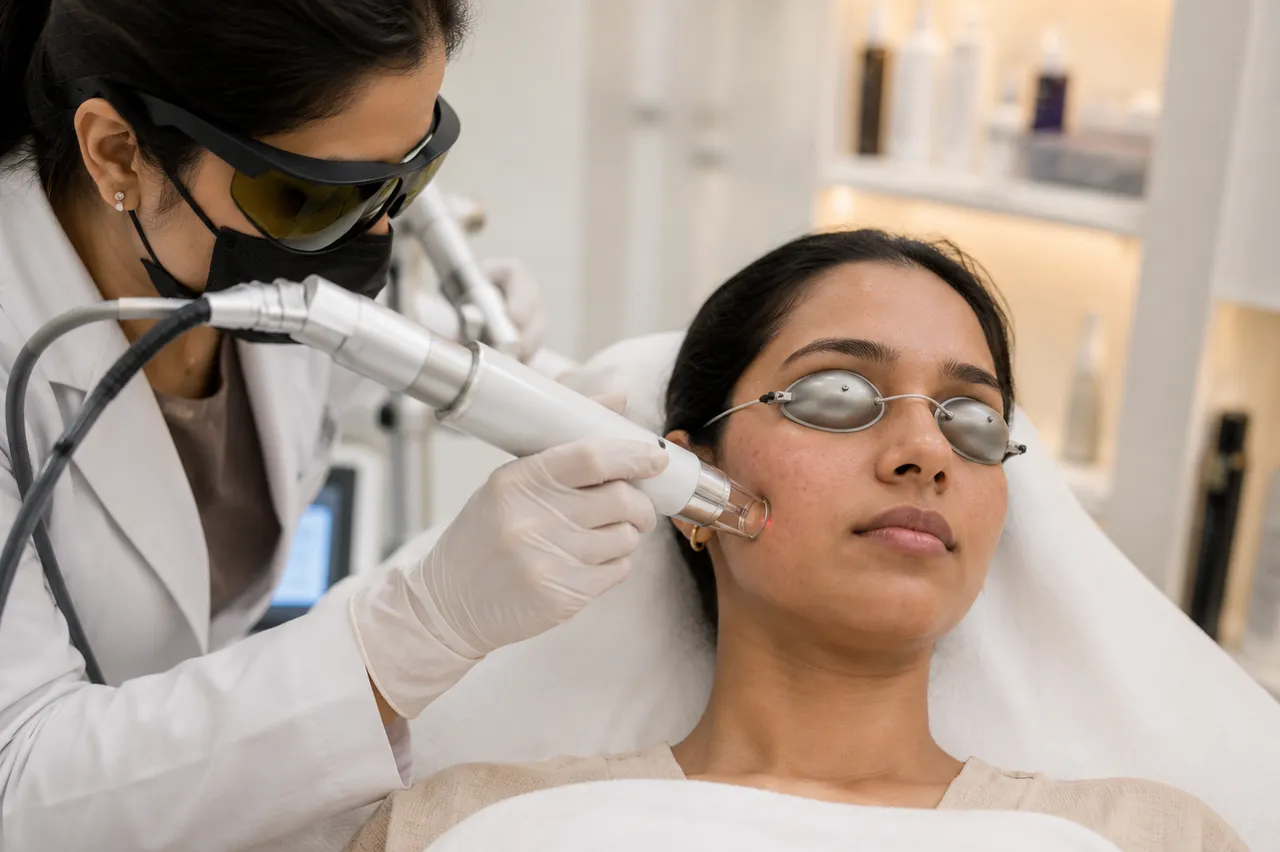
Run a finger over the mark. That one test settles most of it.
If the skin feels smooth and only the colour is off — brown, grey or pink-red — you have a post-acne mark, not a scar. Marks are pigment sitting in skin that healed flat, and they fade with pigment-targeted treatment over a few months.
If you feel a dip, or the mark shows up mainly when light hits your face from the side, that’s a true scar. Scars are texture — tissue lost when the inflammation went deep. They improve with resurfacing, sometimes a lot. They don’t fully vanish.
Most people who walk into our Sector 8 clinic asking to “remove acne scars” turn out to have mostly marks. That’s good news, and it changes the plan completely.
The finger test and the window test
Two minutes, no clinic needed.
Finger test. Clean, dry skin, no makeup. Close your eyes and run a fingertip slowly across the area. Colour you can see but not feel is a mark. A dip, a pit or a wavy unevenness is a scar.
Window test. Stand beside a window so daylight hits your cheek from the side, then tilt your face. Marks look the same from every angle. Scars throw tiny shadows and disappear when you face the light head-on. That’s why your skin can look fine in a selfie and rough in the lift mirror at 6 PM.
Almost everyone has a mix of both. Working out the ratio is the whole point of an assessment.

Clean skin, side lighting, no makeup — that’s how we read marks and scars apart at the first visit.
Scar type vs what realistically helps
| What you see | What it actually is | Realistic approach | Honest expectation |
|---|---|---|---|
| Flat brown or grey patches | Post-inflammatory pigmentation | Pigment-targeted laser sessions plus home care and daily sunscreen | Fades substantially over 3–6 months |
| Flat pink or red patches | Settling blood vessels after inflammation | Sun protection, calming care, time | Often eases on its own in 3–12 months |
| Rolling scars — shallow, wavy dips | Tissue tethered down from underneath | Resurfacing course, sometimes with subcision to release the tether | Softens visibly, edges blur |
| Boxcar scars — sharp, crater-like edges | Wider tissue loss with defined walls | Resurfacing over several months | Partial: shallower, less shadow |
| Ice-pick scars — narrow, deep pinholes | Deep, narrow tracts | Targeted approaches, slow going | Slowest to respond of the group |
| Raised or thickened scars | Overgrown healing tissue | Assessed separately, different protocol | Depends entirely on the cause |
Why creams do so little for texture
A chemist-shelf “scar removal” cream can genuinely lighten a brown mark. It cannot rebuild tissue that isn’t there.
That’s the whole limitation in one line. Topicals act on pigment and surface turnover, so flat marks respond to them. Texture is structural — nothing rubbed on the surface reaches the collagen level where a boxcar scar actually lives.
Same story with the kitchen list: lemon, besan, toothpaste, potato juice. Lemon is the one we’d argue with hardest, because it photosensitises the skin and after a Delhi summer people often come back darker than they left. We see that outcome monthly.
The one at-home thing that genuinely changes scar outcomes is sunscreen. More on that below.
Treat the active acne first. Always.
This is non-negotiable, and it’s why we sometimes tell people to come back later.
If you’re still breaking out, every new pimple is another mark or another scar forming while you pay to treat the old ones. Resurfacing inflamed skin can also spread bacteria and set you back further. So the order is fixed — control the acne, let the skin settle, then treat what it left behind.
That usually means 6–10 weeks on a proper acne plan first. If you haven’t done that step yet, start with our acne treatment guide for Indian skin, which covers what works here and what backfires.

Scar work starts with a plan, not a machine — how many marks, how many true scars, and what order to treat them in.
What we actually use for scars and marks
Pigment-targeted laser. Q-Switch is the mainstay for flat brown and grey post-acne marks on Indian skin. Short sessions, spaced three to four weeks apart, from ₹4,000 a session. Q-Switch details.
Resurfacing for texture. For rolling and boxcar scars, controlled micro-injury that prompts new collagen, done as a course over months. Combined with subcision where a scar is tethered down. Assessed case by case.
Clinical peels. Useful for surface roughness and mild marks — usually a support act, rarely the main treatment.
Deep-clean sessions. A HydraFacial does nothing for scars, and we’ll say so plainly. It keeps pores clear while the acne side is being controlled. Useful, but not scar treatment.
All of it is done by trained professionals under clinical protocols, on internationally certified devices, with settings chosen for Indian skin tones. Your exact plan and pricing come out of the assessment, not a menu.
The honest timeline
Six months. That’s the number we give, and it’s the number people push back on.
- Weeks 1–4 — nothing visible. The skin is still settling.
- Months 2–3 — flat marks start lifting. This is when people first notice it in photos.
- Months 4–6 — texture change becomes visible in side light, which is the hard test.
- Past 6 months — depressed scars keep improving gradually with continued sessions.
Improvement is partial by definition. Over a full course, most people get a meaningful softening of depressed scars rather than a clean slate, and results vary genuinely from person to person. Someone who remembers your acne may still spot it in harsh light. Everyone else won’t.
Sunscreen decides your result
Blunt version — you can do every session correctly and give most of it back by skipping sunscreen.
Pigment-targeted sessions leave skin temporarily more reactive to UV, and Delhi’s UV stays high through most of the year. It reaches you through car windows on the school run and through the office window at your desk. Marks that were fading start darkening again, and you’re back to month one.
Broad-spectrum SPF 30 or higher, every morning, reapplied if you’re outdoors. On indoor days too. It’s the single habit that separates clients who see real change from clients who plateau.
Who this isn’t for right now
- Still actively breaking out. Acne plan first, scars after. Treating in the wrong order wastes money.
- A wedding four weeks away. Scar work needs a six-month runway. For an event, we’d suggest a glow-focused plan instead and start the scar course after.
- Fresh tan or recent strong sun. We postpone rather than risk pigmentation on already-reactive skin.
- A history of raised or keloid scarring. Needs assessment before anything is done.
- Expecting flawless. If the goal is skin that looks like it never had acne, no honest clinic can promise that.
Key takeaway: Run a finger over it. Smooth colour is a mark, and marks genuinely fade over 3–6 months with pigment-targeted sessions from ₹4,000. A dip you can feel is a true scar, and those soften with resurfacing but never disappear entirely. Control the active acne first, then wear sunscreen daily — that habit decides the result more than any single session.
Get an honest read in Dwarka
Come in with clean skin and no makeup, and you’ll leave knowing which of the two you’re actually dealing with — and roughly how much of it is fixable.
Brightonic is in Sector 8, Dwarka, near the Sector 9 Metro, an easy trip from Sector 12, Palam and Janakpuri. WhatsApp +91 74007 60054 with a well-lit photo taken in daylight and we’ll give you a straight first opinion before you spend anything. Book a consultation. Open 7 days, 10 AM–8 PM.
Quick answers
- What is the difference between acne marks and acne scars?
- Run a finger over the spot. If the skin feels smooth and only the colour is off — brown, grey or red — that is a post-acne mark, and it fades with pigment-targeted treatment over a few months. If you feel a dip, that is a true scar. Scars are texture damage and need resurfacing.
- Can acne scars be completely removed?
- No, and any clinic promising that is overselling. True depressed scars — boxcar, rolling, ice-pick — are lost tissue, so treatment softens and blurs them rather than erasing them. Realistic improvement over a full course is partial, usually enough that the scars stop being the first thing anyone notices.
- How long does acne scar treatment take to show results?
- Plan for six months, not six weeks. Flat post-acne marks usually lighten across three to six months of pigment-targeted sessions spaced three to four weeks apart. Depressed scars take longer, because new collagen builds slowly after each resurfacing session. Daily sunscreen decides how much of that progress you keep.
This article is general information from the Brightonic team and is not a substitute for personal medical advice. Suitability and outcomes are assessed individually at consultation.
Considering a treatment?
Book a calm, no-pressure consultation at our Sector 8, Dwarka centre.
Related treatment: Skin treatments in Dwarka