
Ombré Brows, Microblading or Microshading: Which Suits Your Skin?
Ombré brows vs microblading vs microshading in Dwarka — why oiliness decides it, honest costs, healing, and how long each one really lasts.

Oily skin. That single factor decides most of this question, and saying so honestly costs us the mid-priced booking often enough that we may as well lead with it.
If your T-zone shines by 2 PM, ombré or powder brows (from ₹12,000) will hold and microblading (from ₹10,000) will blur. If your skin runs normal to dry, microblading’s individual hair strokes give the most convincing “those are just my brows” result. Microshading (from ₹5,000) is the lighter shaded option — a soft powder wash rather than a full gradient — made for someone who already has reasonable brow hair and only wants the sparse patches filled.
Three techniques, three different jobs. Here’s how to work out which one your skin will actually keep.
The three, side by side
| Technique | From | Suits which skin | How it looks healed | Healing | Realistic longevity |
|---|---|---|---|---|---|
| Microshading | ₹5,000 | Normal, combination, mildly oily | A soft powder wash — brows look gently filled in, not drawn | ~4 weeks, light flaking days 4–10 | 12–18 months |
| Microblading | ₹10,000 | Normal to dry, fine pores, decent skin thickness | Fine hair-like strokes, softer and finer than day one | ~4 weeks, light flaking days 4–10 | 12–18 months |
| Ombré / combination brows | ₹12,000 | Oily, large pores, mature or previously worked-on skin | A gradient — light at the front, denser at the tail, like a lightly pencilled brow | ~4 weeks, slightly heavier shedding | Often closer to 2 years |
Combination brows are what the name says — shaded body, a few hair strokes through the front — the compromise for someone who wants stroke texture on skin that won’t hold pure microblading.
Why oiliness decides it
Microblading places pigment into very fine, deliberate lines, and that line has to stay a line. On oilier skin, sebum and faster surface turnover let pigment diffuse sideways by a fraction of a millimetre — which sounds like nothing until you realise a hair stroke is only a fraction of a millimetre wide to begin with. Six months later the strokes have merged into a soft grey-brown haze. The shape is still there. The illusion isn’t.
Shading never relies on a crisp edge. Thousands of tiny pigment dots build a field of colour, so it fades evenly — lighter powder, not a smudge.
There’s a Delhi layer on top. Between May and July, sweat and humidity keep the skin’s surface working overtime, and brow work placed just before summer softens faster than the same work placed in November. We see it every year in clients from Sector 12, Palam and Uttam Nagar who booked in April for a summer wedding.
A two-minute test. Around 3 PM, press a tissue to your forehead and just above your brows. If it comes away translucent with oil, you’re in ombré territory whatever the reference photo on your phone shows.
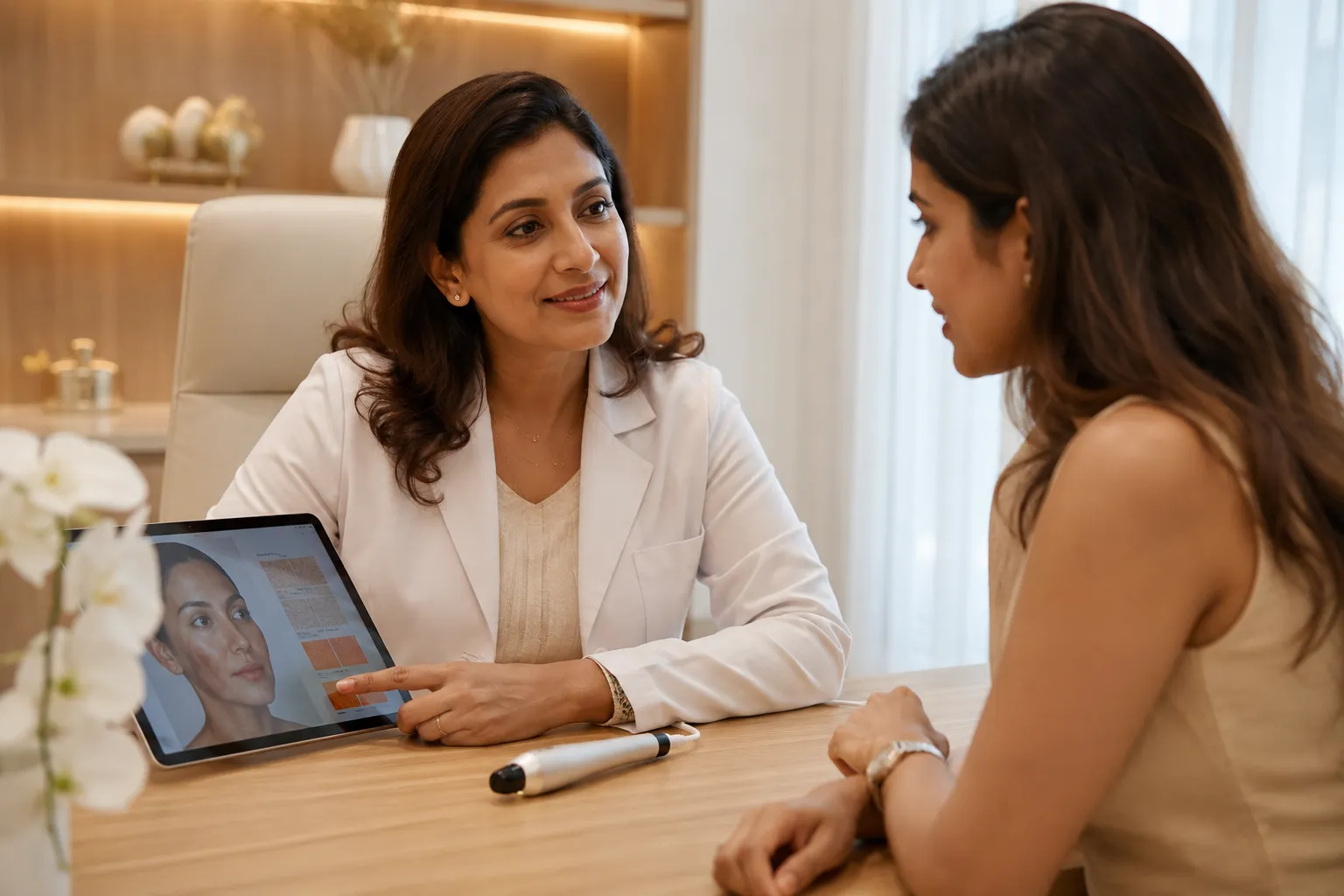
The same skin read that maps pore size and oiliness is what decides the technique — done before any pigment is opened, by trained professionals under clinical protocols.
Fresh versus healed — the gap nobody warns you about
Day one is not the result. All three look roughly 30 to 40 percent stronger on the day than they will at week four. Normal, not a mistake.
- Microblading, day one — crisp, dark, distinctly drawn strokes. Healed — finer, lighter, lower contrast, outermost strokes first to thin.
- Ombré, day one — a firm, filled-in brow, like a pomade-heavy makeup look. Healed — a soft gradient that reads as pencilled, not painted.
- Microshading, day one — stronger than you asked for. Healed — a light wash, which is the point of it.
Which is why day-one photos tell you almost nothing. The microblading guide walks through that healing month day by day.
When age and skin thickness change the answer
Two situations override the oiliness rule.
Mature or thin, crepey skin. Thinner skin holds a fine cut less predictably, so strokes spread. Shading is the sounder call here even on dry skin — softer, and it ages better as the brow itself thins.
Skin worked on before. Old permanent makeup, brow scarring or sun-damaged texture all take pigment unevenly, and hair strokes over that heal patchy.
Very sparse brows aren’t automatically a microblading case either. With almost no hair to blend into, isolated strokes read as drawn-on, and a soft shaded base looks more believable.
The top-up is part of the price, not an add-on
Skin doesn’t accept pigment evenly on the first pass. Expect roughly 10 to 20 percent of the work to drop out during healing — a few strokes that vanish, a tail that lightened more than the rest. Standard, and exactly why the sitting at 4 to 6 weeks exists.
One sitting is not a finished brow. Any quote that doesn’t tell you what the top-up costs is incomplete, ours included — ask and get the number before you book. Our published price list is the starting figure for the first sitting.
What it honestly costs to keep
Year one is the from-price plus the top-up. After that every technique needs a colour refresh — not because anything went wrong, but because semi-permanent means what it says.
Plan on a refresh around 12 months for microblading or microshading, 18 to 24 months for ombré. A refresh is less work than a first sitting and priced accordingly, confirmed at consultation. Over three years, ombré’s higher entry price with longer gaps often lands closer to microblading than the sticker difference suggests.
One running cost people forget. Semi-permanent brows shape the brow you have; they don’t remove hair growing outside that shape. Threading from ₹60 covers it, and for anyone tired of the fortnightly cycle, laser hair reduction from ₹1,500 a session handles the surrounding face — never the brow line itself.

Book the top-up on your way out, while the date still means something. It is the sitting people postpone and then wonder why the tails look thin.
How to judge a technician, not their feed
Day-one photos are marketing. Healed photos are evidence. Four things worth asking before you leave a deposit:
- “Can I see healed work at 6 to 12 months, on oily Indian skin?” Fresh work on dry skin tells you nothing about your outcome.
- “What happens if my skin rejects a section?” A straight answer about the top-up beats a promise that it won’t happen.
- Is the shape mapped and agreed, and are needles opened in front of you? You approve the drawn outline in a mirror first, unrushed. Single-use, every time.
- Do they ever say no? Someone who has never turned a client away is selling, not assessing.
And if a technician recommends microblading for visibly oily skin without mentioning it will fade faster, they’ve told you something useful about how they work.
Where this doesn’t work
- None of it is permanent. All three fade, and all three fade warmer — cool browns drift toward reddish or grey-brown as they break down. Chemistry, not error.
- Correction costs more than the original. Reworking a bad brow takes multiple sittings and still limits what shape is possible afterwards. Choosing on price alone is the most expensive decision here.
- Not during pregnancy or breastfeeding. We postpone and reassess later.
- Not on active skin problems in the area — eczema, acne on the brow, recent sunburn, or skin currently on strong exfoliating or retinoid products near the brow.
- Not two weeks before a wedding. The healing month is real. Book at least eight weeks ahead so the top-up lands before the event, not during it.
- Keloid-prone skin, bleeding disorders or ongoing medical treatment — raise it at consultation and expect an honest yes or no.
Results vary from person to person, and a technique suggested before anyone has looked at your skin is a guess.
Key takeaway: Blot your forehead at 3 PM. Oily tissue means ombré or combination brows from ₹12,000 — microblading strokes blur fastest on oily skin, whatever the photos promise. Dry to normal skin gets the most from microblading from ₹10,000, and microshading from ₹5,000 is the light-touch option for brows that only need filling. Budget for the 4 to 6 week top-up and a refresh roughly yearly, because semi-permanent means semi.
Get the technique matched to your skin in Dwarka
Come with clean brows, no makeup, and the photo you’ve been saving. You’ll leave knowing which of the three your skin will hold — including the times when the honest answer is that the saved look won’t survive on your skin, and a different one will.
Brightonic is in Sector 8, Dwarka, near the Sector 9 Metro and an easy run from Sector 12, Palam and Janakpuri. WhatsApp +91 74007 60054 with a daylight photo of your bare brows. See the permanent makeup service page or book a consultation. Pairing it with a HydraFacial from ₹4,500? Schedule that a week before the brow sitting, never during the healing month. Open 7 days, 10 AM–8 PM.
Quick answers
- Which is better for oily skin, ombré brows or microblading?
- Ombré or powder brows, clearly. Oilier skin diffuses pigment away from the fine cuts microblading relies on, so hair strokes widen, go soft-edged and fade fastest. Shading places thousands of tiny dots instead, so it fades as a lighter powder rather than a smudge. Ombré or combination brows start from ₹12,000 at our Sector 8 clinic.
- What is the difference between microshading and ombré brows?
- Both use shaded dots rather than hair strokes, so the difference is intensity. Microshading is the lighter option from ₹5,000, a soft wash of colour for someone who already has decent brow hair and only wants gaps filled. Ombré or combination brows build a fuller gradient, soft at the front and stronger at the tail, from ₹12,000.
- How long do semi-permanent brows actually last?
- Roughly 12 to 18 months for microblading and microshading, and often closer to two years for well-placed ombré work. None of them are permanent and every one of them fades warmer over time. Oily skin, strong sun and exfoliating acids used near the brow all shorten that range, so most people plan a colour refresh each year.
This article is general information from the Brightonic team and is not a substitute for personal medical advice. Suitability and outcomes are assessed individually at consultation.
Considering a treatment?
Book a calm, no-pressure consultation at our Sector 8, Dwarka centre.
Related treatment: Skin treatments in Dwarka