
Do Hair Extensions Damage Your Hair? An Honest Answer
Extensions get blamed for damage they need not cause. What actually harms hair, which method suits your density, and the warning signs — Dwarka.

Extensions get a worse reputation than they deserve, and part of that is our industry’s fault.
The honest answer: fitted properly, on hair that can carry them, and removed properly, extensions do not cause lasting damage. Almost every horror story we’re shown at the clinic traces back to one of three specific mistakes — and all three are avoidable.
The three things that actually cause damage
1. Weight the hair can’t carry. This is the big one. Every attachment hangs on a small section of your own hair. If the bond is too heavy or the section too small, that hair is under constant tension for weeks. Fine hair with a method designed for thick hair is the classic mismatch, and traction along the hairline is the result.
2. Leaving them in too long. Your own hair grows. As it does, the attachment point travels down the shaft, the leverage changes, and the bond starts pulling at a worse angle. It also begins to tangle with shed hair that can’t escape. Refit windows exist for a mechanical reason, not to sell you appointments.
3. Pulling them out. Tape wefts come off with a proper solvent. Bonds are broken down, not yanked. Clip-ins unclip. Every method has a removal procedure, and the damage we see most often is from someone impatient at home who skipped it.
Notice what isn’t on that list: having extensions at all.
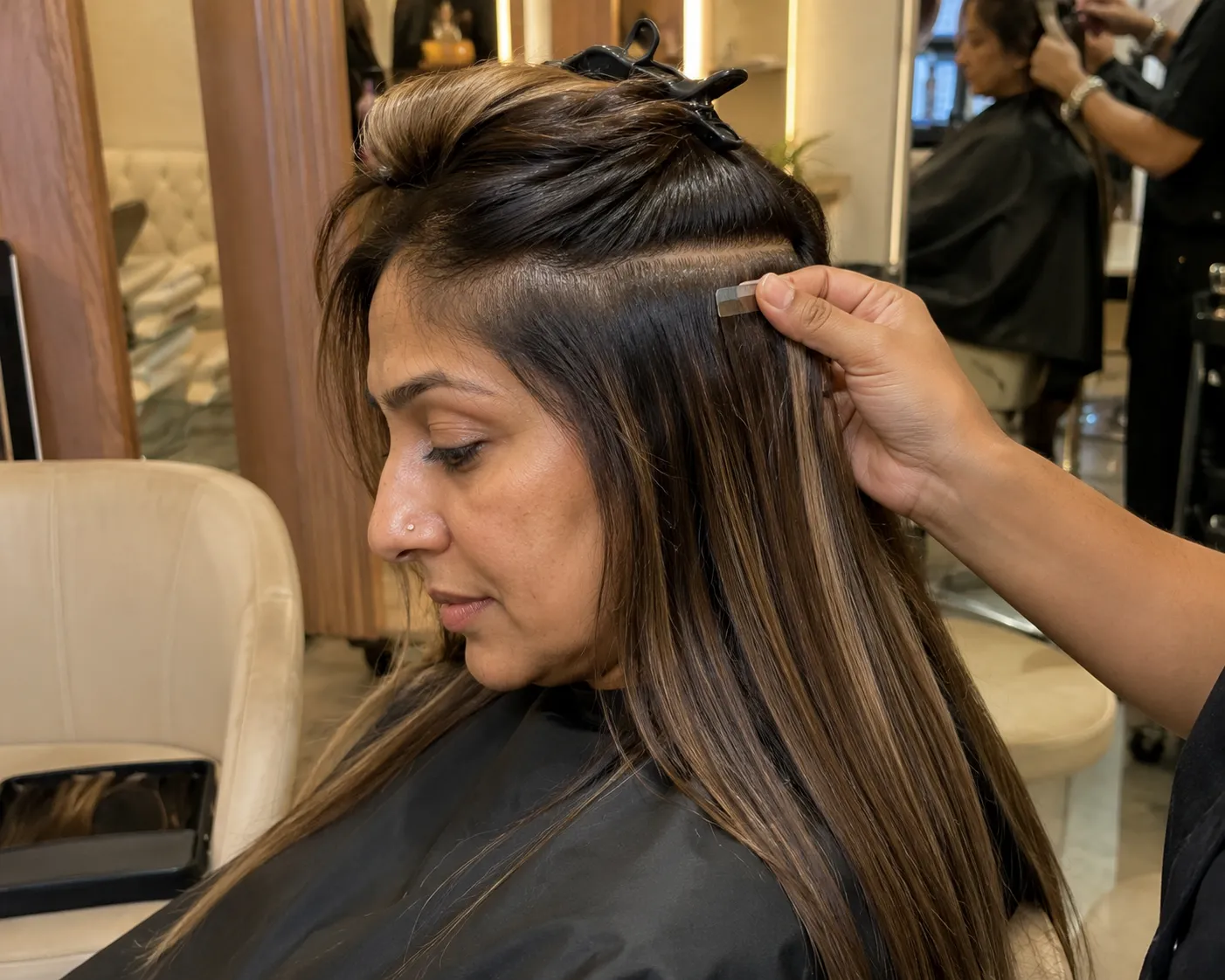
Weight distribution is decided at the application. Wefts spread the load across a band; individual bonds concentrate it on a small section.
Matching the method to your hair
There’s no single best method — there’s the one that suits your density.
| Method | Suits | Trade-off |
|---|---|---|
| Clip-ins | Anyone; occasional wear | Out every night; not for continuous wear |
| Tape-in wefts | Fine to medium hair | Weight spread wide; needs refitting as hair grows |
| Individual bonds | Medium to thick hair | More placement freedom; concentrated load per section |
| Sewn/weft rows | Thick, dense hair | Secure and long-wearing; too heavy for fine hair |
If someone recommends a method without first looking at how dense your hair actually is and how much tension your hairline already carries, that’s the appointment to walk out of.

Active shedding gets investigated and treated first. Extensions on hair that is already falling make the problem worse and hide it.
Who extensions genuinely don’t suit
We turn people away for this, so it’s worth being direct about it.
If you have active hair fall, extensions are the wrong first step. Adding tension to hair that’s already shedding accelerates the problem, and it also hides it from you while it gets worse. The right order is to find out why you’re shedding — and hair fall in Delhi has a long list of causes, from post-viral shedding to thyroid to iron deficiency to seasonal monsoon shedding — treat that, then talk about extensions once things have stabilised. Hair restoration options.
The same applies to a sore or inflamed scalp, and to hair that’s mid-recovery from over-processing. Extensions on brittle bleached hair snap the host hair, not the extension.
The warning signs worth acting on
Two days of mild tightness after a fresh fitting is normal. These are not:
- Soreness or tenderness that persists past 48 hours
- Visible thinning along the hairline or in a line where the bonds sit
- Short broken hairs at the attachment points
- A bond you can see has slid well down the shaft
- Persistent itching or flaking around the attachments
Any of those means come in early. A refit or a partial removal at that stage costs you an appointment; leaving it costs you the hair.
Key takeaway: Extensions don’t damage hair — the wrong weight, an overdue refit and a DIY removal do. Match the method to your density, keep the refit schedule, and never pull them out yourself.
How we handle it
We look at your hair before we quote anything: density, thickness at the root, the state of your hairline, whether you’re currently shedding. Sometimes that conversation ends with a smaller set than you came in for, and occasionally with a recommendation to treat something else first.
Colour matching happens in daylight, not under the salon’s warm bulbs — matched under yellow light, extensions read orange outdoors.
Clients come to us from Sector 8, Sector 12 and Janakpuri, often after a set that was fitted too heavy elsewhere. If that’s you, come in for an assessment before your next refit rather than after.
Quick answers
- Do hair extensions damage your natural hair?
- Properly fitted extensions on healthy hair, removed correctly and given breaks between wears, do not cause lasting damage. Almost all the damage blamed on extensions comes from three things — a bond too heavy for the hair, wearing them too long without a refit, and pulling them out instead of dissolving or unclipping them.
- Which type of hair extension is least damaging?
- Clip-ins, because they come out every night and put no sustained tension on the roots. Among semi-permanent methods, tape-in wefts spread weight over a wider band of hair than individual bonds, so they suit finer hair better. The right method depends on your hair's density and thickness, not on which is trendiest.
- How do I know if my extensions are damaging my hair?
- Watch for scalp soreness that lasts beyond the first two days, visible thinning along the hairline or the bond line, and short broken hairs where the attachments sit. Any of those means the extensions are too heavy or overdue for a refit — get them checked rather than waiting for the next appointment.
This article is general information from the Brightonic team and is not a substitute for personal medical advice. Suitability and outcomes are assessed individually at consultation.
Considering a treatment?
Book a calm, no-pressure consultation at our Sector 8, Dwarka centre.
Related treatment: Hair restoration (PRP & GFC)