
Living With Hair Extensions: Washing, Sleeping and Refits
Hair extension aftercare for Delhi — washing, sleeping, monsoon humidity and refit timing, so a good set lasts. Dwarka clinic guide.

A good set of extensions, cared for properly, looks better in month two than in week one. A good set neglected looks tired in three weeks.
The difference is almost entirely in four habits. None of them is difficult, but they’re not obvious either — and Delhi’s climate adds two wrinkles the international tutorials never mention.
Washing: less often than you think
Your scalp produces oil that travels down your own hair. Extensions get none of it. That’s the single fact that explains all the washing advice.
Two to three times a week. Daily washing strips extensions dry, and dry extensions tangle.
Wash standing under the shower, hair hanging down. Do not pile it on top of your head and scrub — that’s how bonds twist around each other and mat.
Shampoo the scalp, not the lengths. Fingertips into the roots, let the run-off clean the rest.
Conditioner from mid-length down only. Keep it well away from the attachment points; conditioner at a bond loosens it.
Sulphate-free, and skip anything with heavy silicones, which build up on extension hair and dull it fast.
Sleeping: the rule that saves your set
Never sleep on wet hair. That’s it — that’s the whole rule, and it prevents most of the matting we’re asked to fix.
Wet hair swells, moves against itself all night, and by morning the section at the bonds has felted together. Dry fully, brush through with a loop brush or soft bristle, then a loose braid or low, loose ponytail. Tight ties pull at the roots for eight hours.
A silk or satin pillowcase genuinely helps. It’s a small purchase that measurably reduces friction.
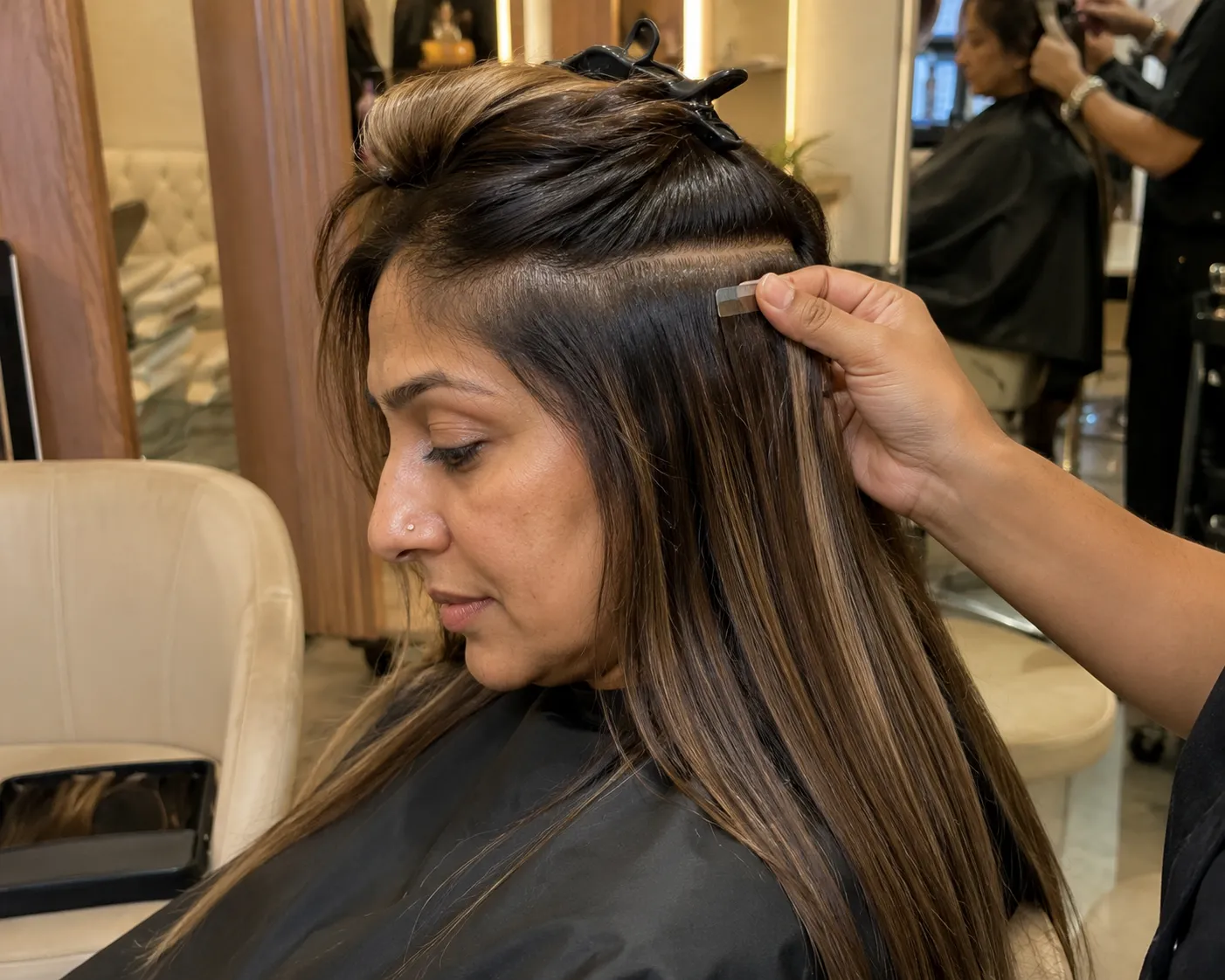
Drying properly at the roots matters most — damp bonds are where matting starts.
Brushing
Twice a day, and always bottom-up: start at the ends, work up in sections, supporting the hair above the bond with your other hand so you’re not tugging at the attachment. A loop brush is designed for exactly this.
If you hit a knot, don’t drag through it. Hold above it and work it loose.
The two Delhi-specific problems
Monsoon humidity. Damp air keeps hair from ever fully drying, and semi-dry extension hair tangles at the bonds. In July and August, dry the root area properly with a cool setting even when the lengths feel fine, and braid before bed without exception.
Dust and pollution. Delhi’s particulate load settles into hair and dulls extensions faster than it dulls your own hair, because there’s no natural oil cycle refreshing them. Tie hair back on high-AQI days and don’t be tempted to compensate by washing daily — that makes it worse. A hydrating mask on the mid-lengths once a week is the better answer.
Heat and colour
Heat tools: low setting, always with a heat protectant. Extension hair cannot repair itself the way living hair partly can, so heat damage is permanent for that set.
Colour: don’t do it at home. Extension hair takes colour differently from your own — often faster and unevenly — and bleach on it is usually terminal. If you want a change, it’s a salon conversation.
Swimming: tie hair up, and rinse with fresh water immediately afterwards. Chlorine and salt both degrade the hair and can loosen bonds.

A set that is refitted on schedule keeps the load off your roots and keeps looking like this.
The refit schedule, and why it isn’t upselling
| Weeks since fitting | What’s happening | Action |
|---|---|---|
| 0–2 | Settling; mild tightness normal at first | Nothing |
| 3–5 | Roots grown a little; still sitting well | Normal care |
| 6–8 | Attachment point has travelled down the shaft | Refit window opens |
| 9–10 | Angle of pull worsening; shed hair collecting at bonds | Refit now |
| 11+ | Tension, tangling and breakage risk rising | Overdue — book immediately |
Your hair grows roughly a centimetre a month whether or not you have an appointment. The refit isn’t cosmetic maintenance; it’s what keeps the load off your roots.
Key takeaway: Wash two to three times a week with the hair hanging down, never sleep on it wet, brush bottom-up twice a day, and refit at six to ten weeks. Those four habits are the difference between a set that lasts and one that damages.
When to call us early
Scalp soreness past the first two days, a bond that’s visibly slipped, matting you can’t gently brush out, or itching around the attachments. Don’t wait for the scheduled refit — early is a quick fix, late isn’t.
We’re in Sector 8, Dwarka, a short walk from Sector 9 Metro, open seven days. Extensions and styling · hair restoration if you are also shedding · book a check.
Quick answers
- How often should you wash hair extensions?
- Two to three times a week, not daily. Extensions have no oil supply from your scalp, so frequent washing dries them out. Use a sulphate-free shampoo, work it into the scalp with your fingertips rather than piling hair on top of your head, and keep conditioner on the mid-lengths and ends only, away from the bonds.
- How do you sleep with hair extensions?
- Never with wet hair — that is when tangling and matting happen. Dry fully, brush through gently, then tie a loose braid or low ponytail. A silk or satin pillowcase reduces overnight friction significantly. Waking up to a tangled mat at the bonds is almost always a wet-hair problem.
- How often do hair extensions need refitting?
- Typically every six to ten weeks, depending on how fast your hair grows and which method you have. As your own hair grows the attachment point moves down the shaft and starts pulling at a worse angle. Refitting on schedule is what protects your natural hair; delaying it is the most common cause of damage.
This article is general information from the Brightonic team and is not a substitute for personal medical advice. Suitability and outcomes are assessed individually at consultation.
Considering a treatment?
Book a calm, no-pressure consultation at our Sector 8, Dwarka centre.
Related treatment: Hair restoration (PRP & GFC)