
Treatment
Hair Extensions & Salon in Dwarka
Hair extensions matched, weighed and fitted to your own hair — with the methods, the real upkeep and the honest limits explained before anything is ordered.
Salon from ₹250 view price list
- Methods
- Clip-in · Tape-in · Bonded · Weft
- Upkeep
- Move-up every 6–8 weeks
- Starts with
- A styling consultation
Four things decide what a set of hair extensions costs — the method, the length, the total grams of hair, and how many times you come back in a year. Nobody can quote that honestly without touching your hair, which is why we weigh, match and price at the styling consultation rather than publishing a figure that would be wrong for most people.
Everything else we can be straight about. Which method suits which hair, what each one costs to keep, and the part most pages skip — extensions don’t damage hair, but tension does, and there are warning signs worth knowing before you sit in the chair.
The four methods, and how each attaches
Clip-in. Pressure combs you open and close yourself. Nothing is fixed to your hair — no adhesive, no move-up, no overnight load on the roots. The honest first step if you’re still deciding whether you like long hair.
Tape-in. Thin pre-taped wefts sandwiched around a fine section of your own hair. They sit flattest of any semi-permanent method, because the weight spreads across a strip instead of hanging off a pinch of strands. The hair itself can usually be re-taped and reused for a couple of cycles.
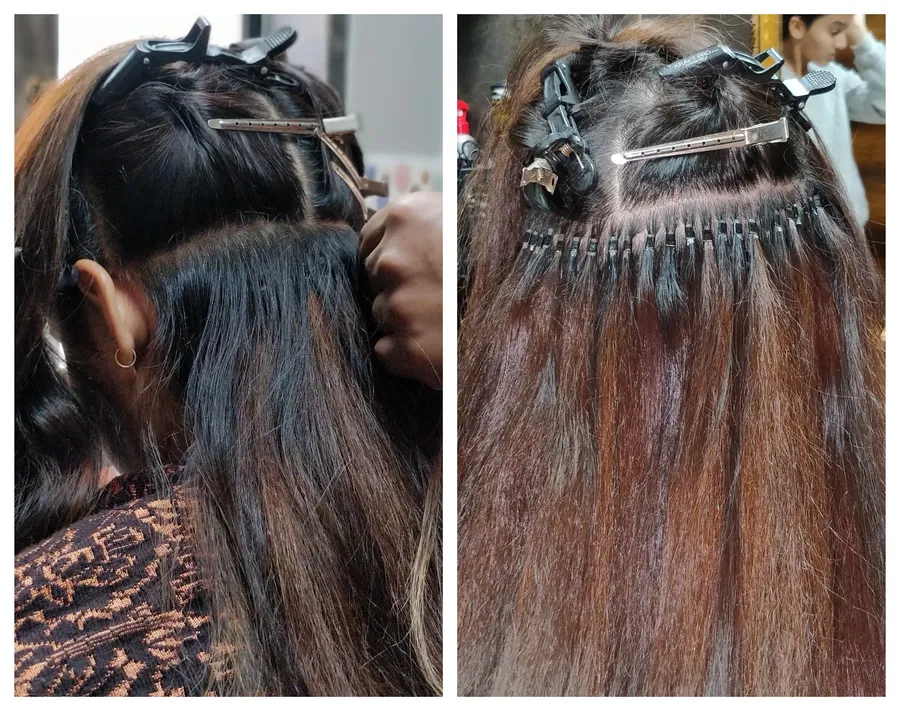
Bonded strand. Strands attached one at a time — a keratin-coated tip melted around a tiny group of your own hairs, or the same strand clamped in a soft metal ring with no heat at all. Dearest in chair time, but each strand moves independently, which is why it survives ponytails and updos best.
Weft. A curtain of hair sewn onto a small braid or mounted on a row of micro-rings. Quickest route to real density, since one row replaces dozens of attachments, and no adhesive touches your hair. It also loads the most weight per centimetre of scalp, so it needs strong hair underneath.
| Method | How it attaches | Typical wear | Back in for | Suits |
|---|---|---|---|---|
| Clip-in | Pressure combs you clip in and out yourself | Hours — off before bed | Nothing scheduled | Testing length, occasion wear, fragile hair |
| Tape-in | Pre-taped wefts sandwiched around a fine section | 6–8 weeks per placement | A move-up every 6–8 weeks | Fine to medium hair; the flattest result |
| Bonded strand | Keratin-tipped or ring-clamped strands on small groups of hair | 3–4 months | Full removal and refit | Medium to thick hair; ponytails and updos |
| Weft | A curtain sewn to a braid or mounted on a ring row | 6–10 weeks | Re-tightening as the braid grows out | Thick, strong hair; genuine density goals |
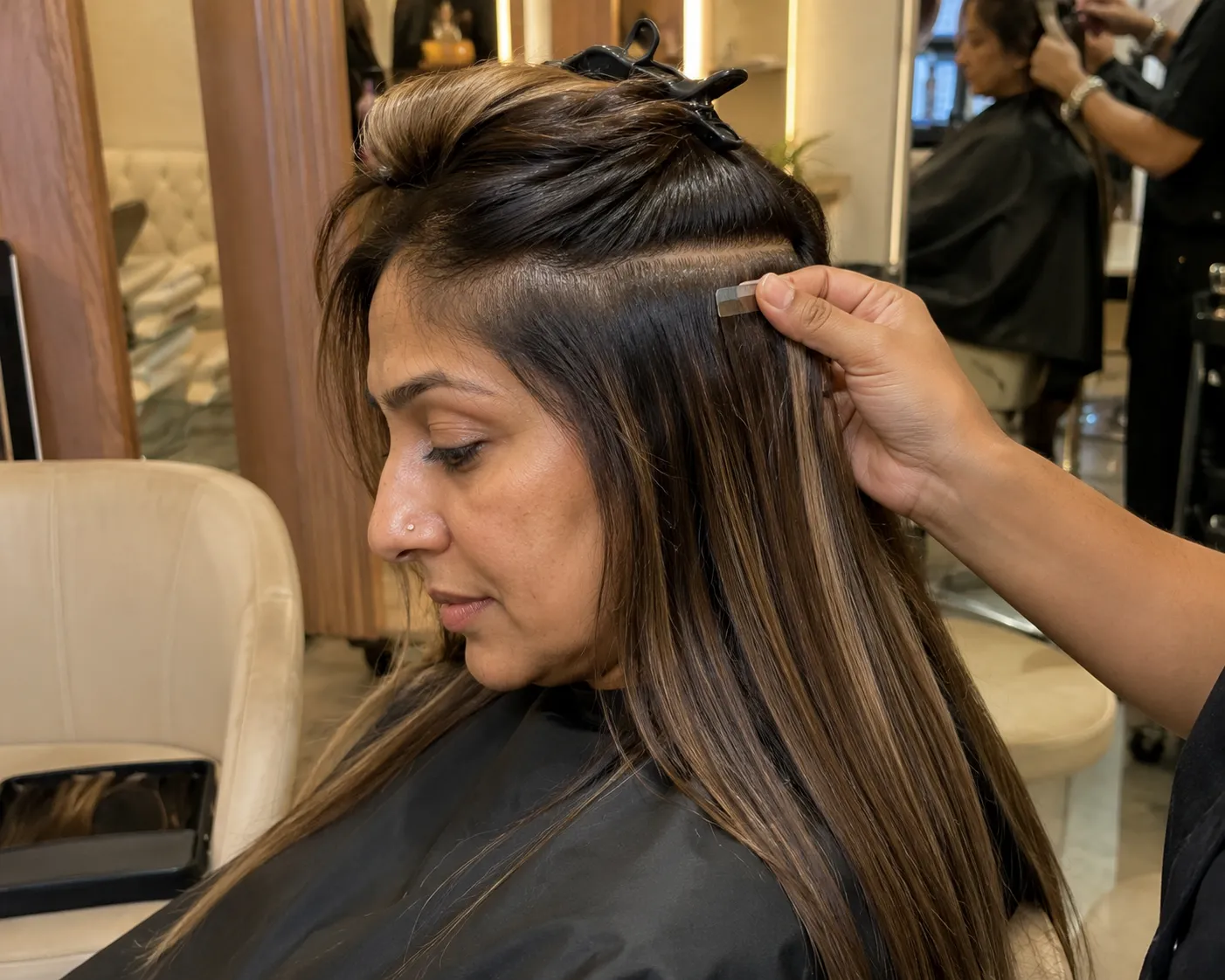
A tape-in weft goes against a thin, clean section — flat to the head, weight spread across a strip rather than loaded onto a few strands.
What actually drives the price
In order of how much each moves the total:
- Grams of hair. The biggest lever by a distance. Extension hair is bought by weight, and a subtle thickening set uses a fraction of what a dense, below-the-waist look needs.
- Length. Long donor hair is genuinely scarce, and the step from shoulder to mid-back to waist isn’t a straight line — it climbs.
- Method and chair time. A full head of individual bonds is a half-day of skilled work. A tape-in set is a fraction of that.
- The year, not the day. Tape-ins on a seven-week rhythm mean seven or eight appointments a year, every year you keep them.
Colour belongs in that sum too. If your base needs a root touch-up from ₹650 or a global colour from ₹3,500 to sit with the new hair, that’s part of the real cost — the full price list carries the salon side. Extension pricing itself is confirmed at the styling consultation, itemised in writing, with no obligation to proceed.
Colour matching is a consultation job, not a photo job
Your hair is almost never one colour. There’s a root shade, a mid-length the sun has lifted, and ends that have been through more than either. Match to the root and the extensions read as a block of flat colour hanging off a dimensional head — which is what people mean when a set “looks obviously fake”.
We match against the mid-lengths and ends, in daylight, hair dry and down. A photo sent over WhatsApp under a warm bulb typically reads a shade and a half off, so we use it to plan and never to order. Where one shade won’t blend, the answer is two or three tones mixed through the set.

Matched at the mid-lengths and ends, not at the root — the most common reason a set stops looking like your own hair.
The damage question, answered honestly
Extension hair is inert. It can’t harm anything. The risk lives entirely in what the attachment does to the follicle underneath, and that mechanism has a name — traction. Sustained pull at the root thins the hair around the hairline and parting, and if it runs long enough that loss stops being temporary.
Three causes, all avoidable: too much weight for the hair underneath, bonds set too tight or placed too close to the fine hair at the hairline, and move-ups stretched too far, which worsens the angle of pull as your hair grows out.
Stop and come in if you notice soreness or a headache-like ache at the roots, itching that doesn’t settle, tenderness around specific bonds, a parting that looks wider than it did, or short broken hairs along the hairline. None of that is worth pushing through until the next appointment.
We strand-test and check the scalp before fitting, and we’ll size a set down — or decline it — when the hair underneath can’t carry the look being asked for.
Living with extensions in Delhi
Hard water. Dwarka’s supply leaves mineral deposit on the shaft, and extension hair — which no longer receives scalp oil — shows it first, as dullness and colour drifting brassy within weeks. A shower filter helps more than any product.
Washing. Sulphate-free, always. Sulphates strip a cuticle that has no way to replace what it loses, and they attack tape adhesive directly. Shampoo at the scalp only, working downward with the fingertips rather than piling hair on top of your head. Conditioner from the mid-lengths down, never onto the bonds — oil at an attachment point is how tape-ins start slipping.
Drying. The step most people get wrong. Never sleep on damp attachments, and skip the towel turban that wrenches the rows. Dry the attachment area first and properly, medium heat, nozzle pointing down the shaft, then finish the lengths. A damp bond is a loose bond.
Season does the rest. Monsoon sweat needs washing out rather than dry shampoo layered over it, and once the AQI climbs from October, a plain rinse after a long commute does more than any leave-in.
The upkeep nobody mentions at the fitting
- Brush twice a day, from the ends up. Hold the hair in your fist above the attachment row so the tension lands in your hand, not on the bonds. Loop or soft-bristle brush, two minutes.
- Sleep in a loose braid. Eight hours of pillow friction is what turns a small tangle at the nape into a matted patch.
- Keep heat tools off the attachments. Lengths only, always with heat protection.
- Book the move-up before you leave. Six to eight weeks for tape-ins, and far easier to keep when the appointment already exists.
- Wet your hair before the pool. It absorbs less chlorine, and chlorine accelerates slippage.
When extensions are the wrong answer
We turn this work down more often than people expect:
- Active shedding. More hair in the brush than usual, a widening parting, a thinner ponytail. Adding weight to follicles already letting go makes it worse, and covering the area means nobody sees the trend.
- Any scalp condition — flaking, persistent itch, sore or inflamed spots, bare patches.
- Postpartum shedding. It usually settles on its own. Wait it out.
- Heavily over-processed hair that snaps mid-shaft or goes gummy when wet. Attachments on brittle hair break the hair, not the bond.
- A medical or hormonal driver — thyroid, iron, PCOS, medication. Treat the cause first.
In each of those cases the right first appointment is a hair and scalp assessment, not a styling consultation — see hair restoration for what that involves. Extensions stay on the table for later. They just aren’t the next step.
Key takeaway: Match the method to your hair, not to the photo — tape-ins for fine hair, bonded strands for updos, wefts for real density, clip-ins if you’re still deciding. Cost is driven by grams, length, chair time and the six to eight move-ups a year, quoted after your hair is weighed and matched rather than before. Extensions don’t damage hair; unmanaged tension does, so treat root soreness or a widening parting as a reason to come in early.
Book a styling consultation in Dwarka
Come in with your hair dry, down and free of styling product, and bring the reference photo you keep going back to. You’ll leave knowing which method your hair can carry, what the colour match needs, and what a year of upkeep adds up to — including the cases where we’d tell you to wait.
Brightonic is in Sector 8, Dwarka, near the Sector 9 Metro and an easy run from Sector 12, Palam, Janakpuri and Uttam Nagar. WhatsApp +91 74007 60054 with a daylight photo of your hair down and we’ll tell you what’s realistic before you come in. Book a consultation. Open 7 days, 10 AM–8 PM.
Suitability, method and pricing are confirmed at consultation. Wear time and results vary with hair type, density and lifestyle.
Hair Extensions & Salon in Dwarka — your questions
How much do hair extensions cost in Dwarka?
There is no single price, because four things move it — the method, the length, the total weight of hair used, and how often you return for move-ups. A short, light set costs a fraction of a long, dense one. We weigh and quote yours at the styling consultation before anything is ordered, so the figure you hear is the figure you pay.
Do hair extensions damage your hair?
The extensions themselves do not damage hair. Tension does. Every method hangs weight from your own strands, and if a bond is set too tight, worn too far past its move-up, or fitted to hair that is already fragile, that steady pull thins the roots at the hairline and parting. Correct weight, correct placement and on-time move-ups are what keep the risk low.
How often do tape-in extensions need a move-up?
Every six to eight weeks. Your own hair grows roughly a centimetre a month, so the weft drifts away from the scalp, becomes visible, and starts pulling at a worse angle. At a move-up the wefts are lifted off, the hair is cleared of residue and product, and everything is reset close to the root. Stretching past ten weeks is where most damage happens.
Which hair extension method suits fine hair?
Tape-in wefts, in a light set. They lie flat, spread the weight across a wide surface instead of loading a few strands, and add almost no bulk at the root. Bonded strands and sewn wefts concentrate more weight per attachment point, which fine hair tolerates poorly. Clip-ins stay the lowest-risk option of all, because nothing is worn overnight.
Can I get extensions if my hair is falling out?
Not before the shedding is assessed. Extensions add weight to follicles that are already struggling, and they cover the exact area that needs watching. Sudden shedding, a widening parting, itching, flaking or visible scalp needs a proper hair and scalp assessment first. Once the cause is being treated and the shedding has settled, extensions become a reasonable conversation again.
Serving Dwarka, Sector 8 Dwarka, Raj Nagar Extension, Sector 7 Dwarka, Sector 6 Dwarka, Sector 12 Dwarka and nearby areas of South-West Delhi.
From the Journal