
Hair Extensions in Dwarka: Methods, Damage Risk and Real Maintenance
Hair extensions in Dwarka — clip-in, tape-in and bonded methods compared, the real damage risk, and the maintenance most people underestimate.

Clip-ins come out every night, so nothing pulls on the root while you sleep. Tape-ins sit flat against the head and need moving up every six to eight weeks. Bonded strands last the longest and are the least forgiving on fine hair.
That’s the decision in three lines — because with extensions, the method matters more than the hair. You’re adding length, density or both by attaching wefts or strands to your own hair close to the root, and every method trades staying power against how much weight your roots carry.
Cost follows the same logic. There’s no flat rate: grams of hair, length, method and hair quality set the number, and pricing is confirmed at the styling consultation once we’ve actually looked at your hair. Here’s what we tell clients in the chair — including the times we say no.
The four methods, side by side
| Method | How it attaches | Typical wear | Maintenance interval | Suits which hair |
|---|---|---|---|---|
| Clip-in | Small pressure clips grip a section; you fit and remove them yourself | Hours — out before bed | None, beyond washing the pieces every 8–10 wears | Almost anyone, including fine hair and shedding phases |
| Tape-in | Thin adhesive wefts sandwich a fine slice of your own hair, flat to the head | 6–8 weeks per placement | Move-up every 6–8 weeks | Straight to wavy hair of medium density — the flat profile hides well |
| Micro-ring / bead | Small rings clamp a strand or weft to your hair. No heat, no glue | 8–10 weeks | Re-tighten every 8–10 weeks | Medium to thick hair that can hold the ring without sliding |
| Bonded strand | Individual strands fixed one by one with a keratin-type bond | 3–4 months | Full removal and refit | Thick, healthy, non-shedding hair only |
Read the last column first. It decides for you far more honestly than the price does.
The pattern we see weekly at the clinic: someone arrives set on bonded strands because a friend’s lasted four months, and their hair density says tape-in or nothing. Fitting a method your roots can’t carry is how good hair ends up broken.
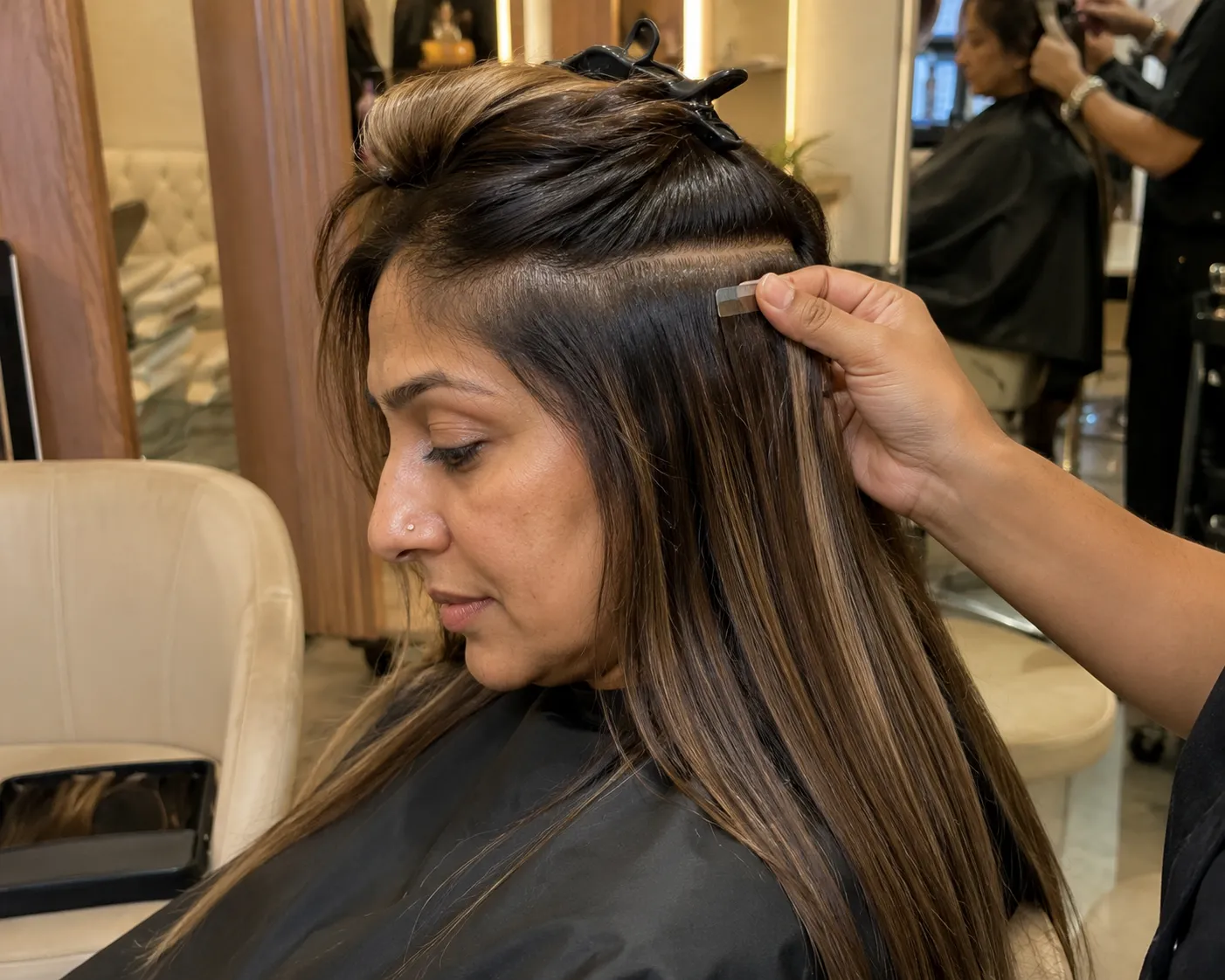
A tape-in weft going onto a clean, thin section about a centimetre below the parting — placement is what decides whether it disappears or announces itself.
Do extensions damage hair?
Not on their own. Traction does.
The extension is inert. What causes trouble is sustained pull on the follicle — too many grams for the density, bonds set too tight, wefts left in past their move-up date, or a client yanking a brush through a tangle at the attachment point. Do that for months and you get traction hair loss, usually first at the temples and the front hairline.
That’s the honest risk, and it’s avoidable. It’s also why the weigh-up before fitting matters more than the fitting itself.
Signs to stop and get it checked, not push through:
- Tenderness or a headachy soreness at the attachment points that lasts beyond the first day or two
- Short broken hairs collecting just below where the bonds sit
- The parting looking wider than it did before you started
- Bonds sliding down noticeably faster than the last cycle
- Persistent itching, flaking or soreness on the scalp
Any of those and the answer is removal and a look at the scalp — not a tighter refit.

Every attachment point carries weight. Spacing, section size and grams are chosen for the density that’s actually there — which is why the same “full head” means different things on different heads.
What actually sets the price
Four things move the number, and none of them is the salon’s mood.
Grams of hair. Adding length to fine, mid-back hair takes far less than building density through a layered cut. This is the single biggest driver.
Length. Longer hair costs more per gram, not just more grams — long, cuticle-aligned lengths are simply scarcer.
Method and fitting time. Clip-ins are one appointment. A full bonded head is hours of individual strand work, and you’re paying for that chair time.
Hair quality. Cuticle-aligned hair that behaves like your own costs more than processed, coated hair. The difference doesn’t show on day one. It shows on wash eight.
Then there’s the part nobody totals up front: maintenance visits across a year. Tape-ins at six to eight weeks means roughly seven or eight move-ups annually. Budget for the year, not the fitting.
Pricing is confirmed at the styling consultation. We’d rather quote after seeing your density, your cut and your routine than throw a figure at a WhatsApp message.
Delhi is genuinely hard on extensions
Your own hair gets oil and repair from the scalp. Extensions get nothing. Whatever the city does to them stays done.
Hard water. Much of Dwarka runs hard, and mineral deposit builds a film that makes extension hair stiff, dull and grabby — usually first at the nape. A sulphate-free shampoo is not a nicety here; harsh detergent strips what little conditioning coating remains and accelerates the problem.
Monsoon humidity. Damp bonds are weak bonds. Tape adhesive in particular softens and slips when it stays wet, which is why the drying routine matters more than the washing one.
Dust and winter AQI. From October, hair gets dirty faster and people wash more often. More washes on the same hair means gentler product and a proper wash technique carry more weight than they would elsewhere.
The practical routine: wash upright in the shower rather than tipping your head forward, keep conditioner to mid-lengths and ends only, and dry the root area and bonds properly before you sleep or tie anything up.
And the specifically Indian one — no oiling at the roots. A champi at the parting will soften tape adhesive and slide micro-rings. Oil the lengths if you want to; keep it well away from the attachment line.
The maintenance most people underestimate
Extensions are a routine, not a purchase.
Move-up visits. Hair grows about a centimetre a month. By week seven a tape-in weft has travelled far enough from the root to be visible when you tie your hair back, and far enough to start levering on the follicle.
Brushing, twice a day, in the right order. A loop brush, ends first, working upward, with your free hand holding the hair above the bond so the pull never reaches the root. Skip two days and you’ll spend twenty minutes fixing a matted nape.
Sleeping. A loose braid or low plait, always. A satin or silk pillowcase saves a surprising amount of friction. Never sleep on wet extensions.
Heat and chlorine. Keep straighteners and dryers off the bonds themselves. Tie hair up before a workout, and rinse immediately after a pool.
That’s roughly ten minutes a day plus a salon visit every six to eight weeks. If that doesn’t fit your life, clip-ins genuinely are the smarter answer, and we’ll say so.
When extensions are the wrong answer
This is the part most salons skip, so we’ll be direct.
Extensions are a styling solution, not a treatment for hair loss. They add hair over the top. They don’t do anything for what’s happening underneath.
If you’re shedding heavily, if your parting has widened over the last year, if the crown is showing through, or if the scalp is flaky, itchy or sore — that gets assessed before anyone talks about wefts. Adding weight to hair that’s already shedding makes the shedding worse, and we’ve seen clients arrive after exactly that sequence somewhere else. Thinning with a cause behind it belongs with hair restoration, not with extensions.
Genuinely fine, low-density hair. There may not be enough anchor hair to hide a bond or cover a tape edge. Clip-ins for occasions are often the only honest recommendation.
Cheap hair looks cheap within weeks. Heavily processed hair is silicone-coated to feel silky in the box. That coating washes off in six to eight washes, and what’s left tangles at the nape, dulls, and won’t hold a blow-dry. Paying twice is the usual outcome.
Before a wedding week. Fit two to three weeks ahead, never two days. Hair needs to settle, and you want time to fix a colour match rather than discover it under photography lights.
Results vary with hair type, density and routine — nobody can tell you how a fitting will sit without seeing your hair first.
Key takeaway: The method decides almost everything. Clip-ins come out nightly, so nothing pulls on the root overnight. Tape-ins sit flat and need a move-up every six to eight weeks. Bonded strands last three to four months but need thick, non-shedding hair to sit on. Traction is the real damage risk, not the extension itself — and if you’re actively losing hair, get the scalp assessed before you add any weight to it.
Talk it through in Dwarka
Bring your hair as it normally is — no fresh blow-dry, no clips — and we’ll tell you which method your density can carry, roughly how many grams it takes, and what a year of upkeep looks like before you commit to anything.
Brightonic is in Sector 8, Dwarka, near the Sector 9 Metro, an easy run from Sector 12, Palam, Janakpuri and Uttam Nagar. WhatsApp +91 74007 60054 with a photo of your hair in daylight, tied back, and we’ll tell you honestly whether extensions are the right call. See hair extensions and salon or book a consultation. Open 7 days, 10 AM–8 PM.
Quick answers
- Which hair extension method is least damaging?
- Clip-ins, by a distance — they go in for the evening and come out before bed, so nothing pulls on the root overnight. Tape-ins come next, because the weight spreads across a flat weft instead of a few strands. Bonded strand methods concentrate weight into small points, which is why they suit thick hair best.
- How much do hair extensions cost in Delhi?
- There is no single number, because the cost tracks four things — how many grams of hair you need, the length, the method, and the quality of the hair itself. Maintenance visits then add up across a year, and most people forget to count those. Pricing is confirmed at the styling consultation, once we see what your hair can carry.
- How often do tape-in extensions need to be moved up?
- Every six to eight weeks. Your own hair grows roughly a centimetre a month, so by week seven the weft has travelled far enough down the strand to catch the light and to tug. A move-up appointment lifts the tapes off, cleans the hair, and refits the same wefts higher up near the root.
This article is general information from the Brightonic team and is not a substitute for personal medical advice. Suitability and outcomes are assessed individually at consultation.
Considering a treatment?
Book a calm, no-pressure consultation at our Sector 8, Dwarka centre.
Related treatment: Hair restoration (PRP & GFC)